news
220 Degrees on Medium Format: AstrHori's 8mm F2.4 Circular Fisheye
AstrHori's manual focus 8mm F2.4, announced on October 16 for Fujifilm GFX and Hasselblad XCD at $398, sees more than a hemisphere. It is the widest lens either system has, and a useful test of what medium format is for.
AstrHori
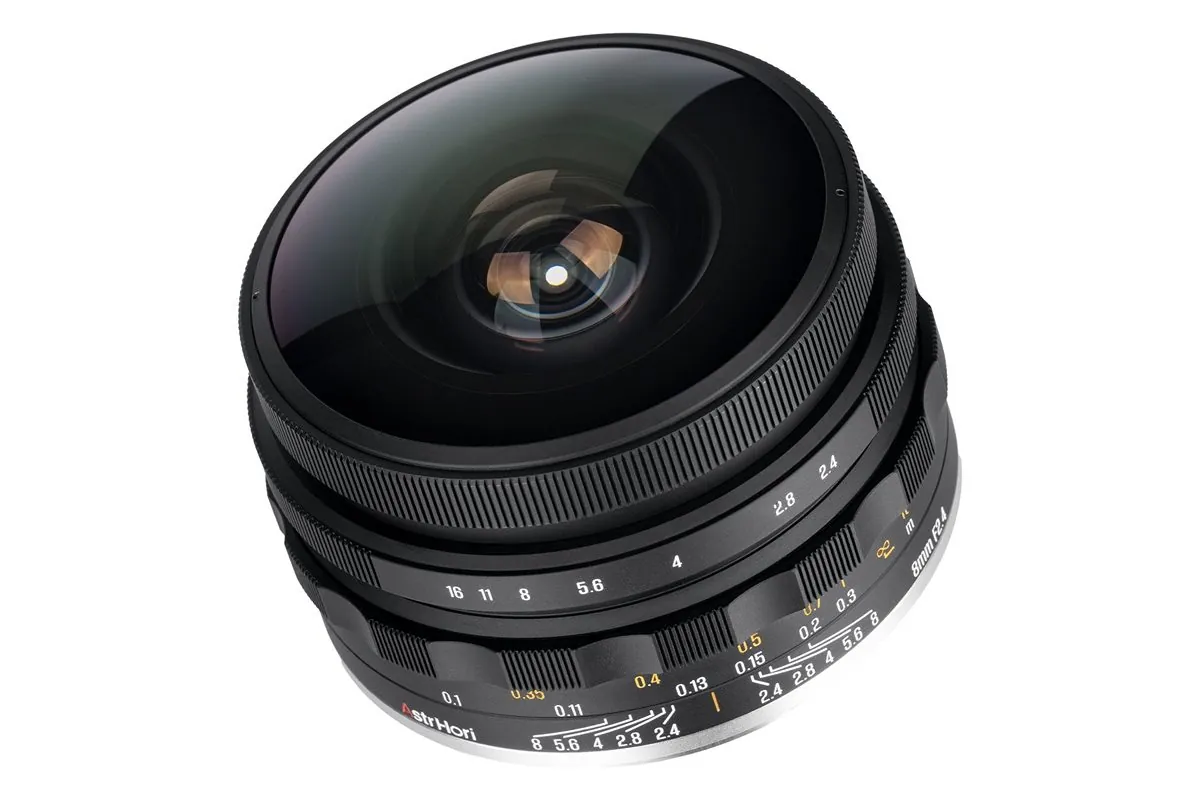
A conventional fisheye sees a hemisphere: 180 degrees, everything in front of the camera and nothing behind the plane of the front element. AstrHori's MF 8mm F2.4 Circular Fisheye, announced on October 16 for Fujifilm GFX and Hasselblad XCD mounts, is specified at 220 degrees. It sees, in part, behind itself. On medium format cameras whose widest native lenses stop at the equivalent of a moderate wide angle, it is now the widest lens available for either system, at a price of $398.
The focal length needs translating. On the 44 x 33 millimetre format, 8mm corresponds to roughly 6mm in full frame terms, a field of view no rectilinear lens approaches. The image is circular, projected as a disc inside the frame rather than filling it, which is the defining bargain of the circular fisheye: geometry is surrendered entirely, and in exchange the photograph can contain the whole of a room, a ceiling and floor in one exposure, or a night sky from horizon to horizon with the ground beneath the tripod included.
The optical bill for 220 degrees
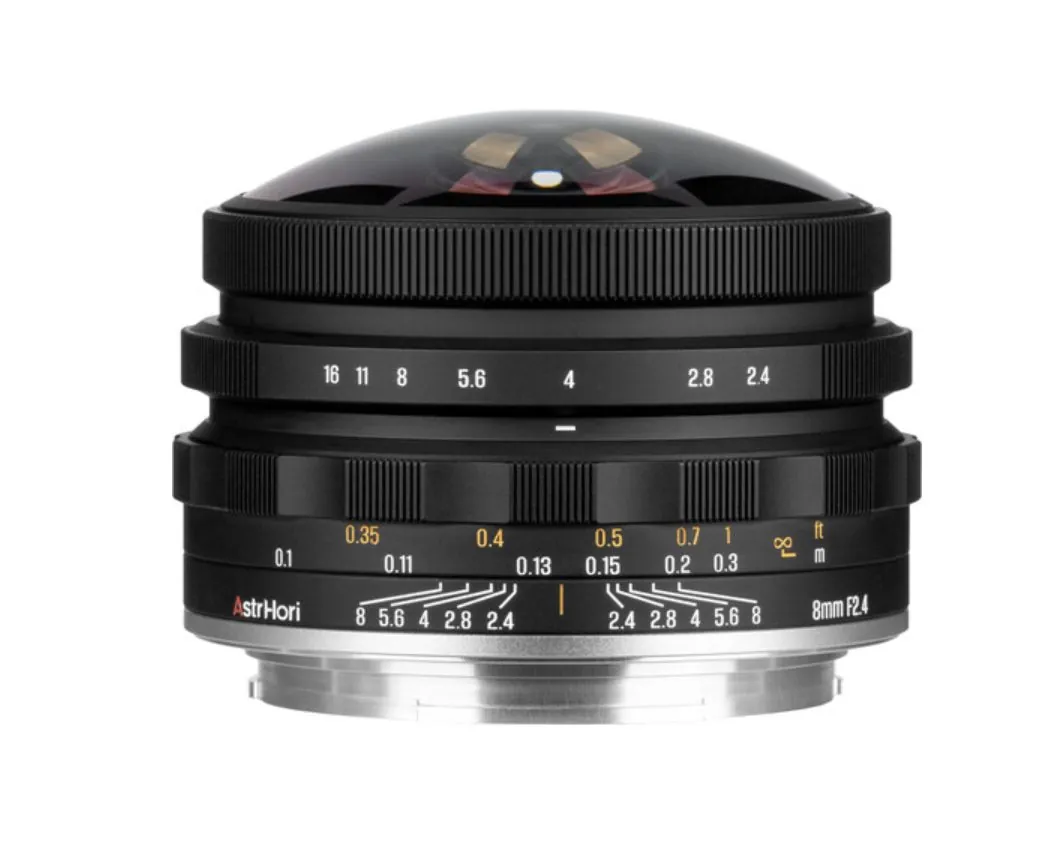
The optical formula totals ten elements arranged in eight groups. Two elements use high refractive index glass and two more are of extra low dispersion type, the latter pairing there to discipline colour fringing at the edge of an image circle stretched far beyond ordinary practice. The aperture range is f/2.4 to f/16 through a ten blade diaphragm, and the minimum focus distance is 0.1 metres, close enough that at the closest setting the subject nearly touches the front element while the surroundings wrap around it. Focus is manual, set by scale, as it is on every lens of this type; at 8mm on this format, depth of field does most of the work in any case.
AstrHori
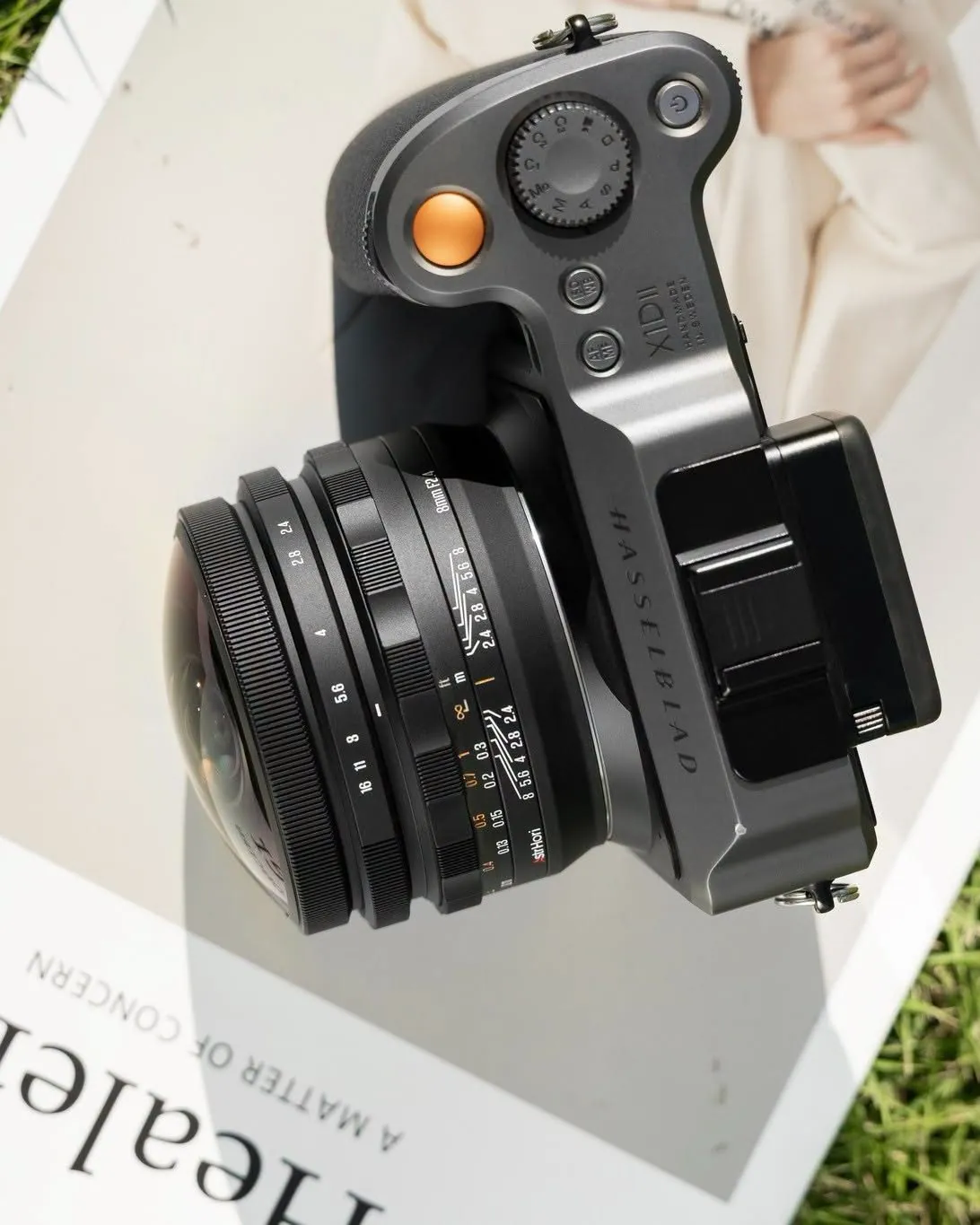
The barrel is all metal, 80 millimetres in diameter, and differs slightly by mount: the GFX version is 62 millimetres long and weighs 511 grams, the XCD version 65 millimetres and 536 grams. Those are substantial figures for a lens of this price, and they reflect the glass a 44 x 33 image circle demands even at a short focal length. There are no electronic contacts, no autofocus and no recorded EXIF lens data. Owners coming from system lenses should expect a fully manual instrument whose results announce themselves.
What a lens like this is for
AstrHori promotes the lens for landscape, architecture, street and astrophotography, and for dynamic action work. The honest list is shorter and more specific. Circular fisheyes earn their keep where the subject is an environment rather than an object: interiors that must be taken in whole, planetarium style skies, immersive documentation, and deliberate visual distortion used as a style rather than an effect. On a 100 megapixel medium format body, the circular image still resolves tens of millions of pixels within the disc, which makes cropping into the circle a practical option rather than a compromise, and is the one argument for putting a $398 lens in front of a five figure sensor that survives scrutiny.
AstrHori
Two smaller details complete the specification. The aperture ring is clicked rather than smooth, a choice that suits stills work and gives the ten blade diaphragm a secondary use: stopped down against point light sources, a ten blade design produces the defined sunstars that PetaPixel notes the lens promises. And the lens is a shipping product, not an announcement of intent; it can be ordered now in both mounts through AstrHori's own store and the usual specialist retailers, with B&H listing it for preorder at the same $398.
Price is the lens's second argument. At $398, with an introductory price of $359 that ran to October 20, it costs less than the lens hood of some medium format system lenses, in systems where the makers' own wide angles cost several thousand. AstrHori is a young Chinese manufacturer whose catalogue is built on exactly this proposition: manual, mechanically simple lenses for mounts the majors serve expensively or not at all. This publication has not tested the 8mm, and optical judgements, particularly about edge colour and flare with light sources inside a 220 degree field, wait on use.
Taken with this week's patent news from Tamron, the fisheye marks a pattern worth watching. Medium format's lens story is starting to be written by outsiders: a $398 manual fisheye at one end, documented designs for fast autofocus class primes at the other. The systems' owners built their reputations on closed, first party glass. The interesting question for 2027 is how long that remains the whole story.
Specifications
| Focal length | 8mm (about 6mm full frame equivalent on 44 x 33mm) |
|---|---|
| Angle of view | 220 degrees, circular fisheye |
| Aperture | f/2.4 to f/16, 10 blades, manual focus |
| Construction | 10 elements in 8 groups, including 2 high refractive index and 2 ED elements |
| Minimum focus | 0.1m |
| Size and weight | 80 x 62mm, 511g (GFX); 80 x 65mm, 536g (XCD) |
| Price | $398 |
Spotted an error? We correct openly: see our corrections policy.