news
Tamron Gives APS-C a Proper Fast Zoom, in Four Mounts at Once
The 16-50mm F2.8 A, Model B091, starts at a genuinely wide 16mm, holds f/2.8 across the range, weighs about 305 grams, and rolls out from October 29 at $529 and $549.
Tamron
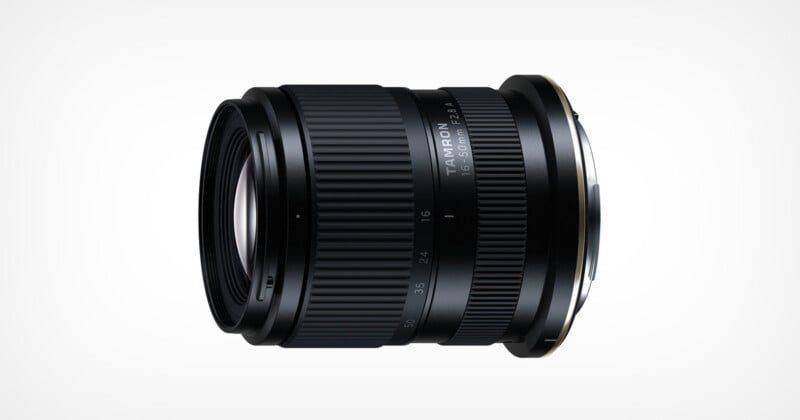
Tamron announced the 16-50mm F2.8 A (Model B091) on October 14: a fast standard zoom designed for APS-C mirrorless cameras, and notable less for any single specification than for the breadth of its ambition. One optical design will serve four mounts, Sony E, Canon RF, Nikon Z and Fujifilm X, on a staggered release running from late October to mid December. The lens holds a constant f/2.8 aperture across its range, starts at a true wide angle, and weighs little more than 300 grams. That combination has been promised to APS-C photographers for years. Tamron is now shipping it, four times over.
The range itself is the first argument. On Sony, Nikon and Fujifilm bodies the 16-50mm frames like a 24-75mm on full frame; on Canon RF bodies, with their slightly larger crop, the equivalent span is 25.6-80mm. The wide end matters most. Many standard zooms for the format begin at 18mm, which in practice crops the edges off interiors, architecture and group photographs taken in confined spaces. Starting at 16mm gives the photographer the full wide view a standard zoom is supposed to start from, while the 50mm end reaches a useful short telephoto for portraits. It is one lens, honestly specified, for the subjects a standard zoom actually covers.
Tamron
Small enough to stay on the camera
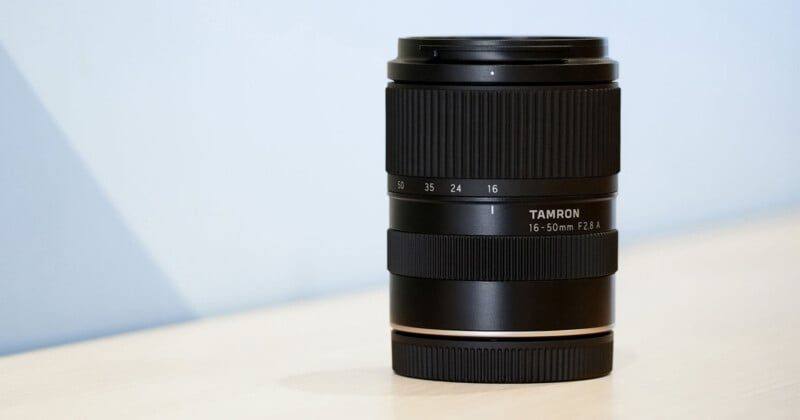
The physical numbers decide whether a lens like this gets used. Weight runs from 305 grams for the Sony E, Fujifilm X and Canon RF versions to 315 grams for the Nikon Z version. Length runs from 77.6mm on RF mount to 81.6mm on Z mount, with the E and X versions at 79.6mm and 79.9mm. The filter thread is a modest 55mm. Optically the design uses 14 elements in 10 groups behind a seven blade diaphragm, and Tamron fits moisture resistant construction and a fluorine coating on the front element. A flower shaped hood and caps are included, and the front cap carries a strap hole, a small handling detail aimed at a lens that is meant to live on the body rather than in a cabinet.
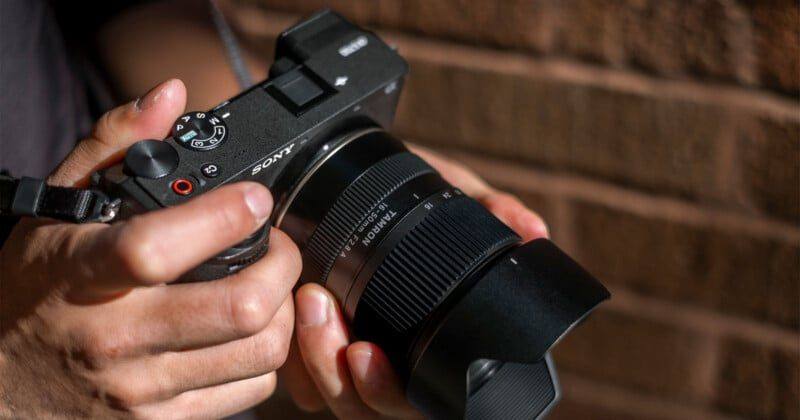
The consequence is worth stating plainly. A constant f/2.8 zoom at this weight changes the APS-C calculation. The format's traditional bargain was smaller and lighter equipment in exchange for slower kit zooms, with fast glass available mainly as primes or as adapted full frame lenses that surrendered the size advantage. A 305 gram f/2.8 standard zoom removes that exchange. The camera stays light, the aperture stays fast in low light and at every focal length, and the system keeps the one advantage APS-C has always claimed over full frame: you carry it.
Autofocus and close focus
Autofocus is handled by Tamron's VXD linear motor drive, the voice coil system the company uses across its current mirrorless range, specified here for fast and precise tracking of moving subjects in both stills and video work. Close focus is unusually ambitious for a standard zoom. The minimum object distance is 0.15 metres at the wide end and 0.29 metres at 50mm, giving maximum magnification of 1:4.5 and 1:4.8 respectively. That is not macro territory, and Tamron does not claim it is, but it is close enough for the detail work, food, objects and near portraits, that standard zooms are routinely asked to do.
Tamron
Four mounts, three dates
The release is staggered by mount. Sony E and Canon RF versions arrive on October 29, 2026, priced at $529 and $549 respectively. The Nikon Z version follows on November 19 at $549. The Fujifilm X version closes the sequence on December 17 at $529. The two tier pricing appears to track mount licensing rather than specification, since the optics are shared: Tamron's own documentation notes the lens is produced under licence agreements with Sony, Nikon and Canon for their respective mounts.
The four mount strategy is the larger story. Third party makers once treated APS-C as a single mount afterthought. Tamron is instead building one fast standard zoom and adapting it across every major APS-C system at launch, including mounts where the manufacturer's own fast standard zoom costs considerably more. For photographers, the effect is standardisation: the same lens, the same handling and the same rendering, available whichever badge is on the camera. For Tamron, it spreads one optical design across four customer bases. The B091 is not a headline lens. It is a foundational one, and foundations are where systems are won.
Spotted an error? We correct openly: see our corrections policy.