feature
Fujifilm GFX and the Modern Medium-Format Market
While rivals fought over full frame, Fujifilm built a medium-format system from nothing. Nine years on, the GFX line is the clearest argument that larger sensors have a future.
Amateur Photographer
Fujifilm never joined the full-frame mirrorless war. Instead it flanked it, dominating APS-C from below and building a medium-format system from scratch above. The GFX series, announced with the GFX 50S in February 2017, was the company's bet that photographers would pay for a sensor measuring 43.8 by 32.9 millimeters, roughly 0.79x the linear dimensions of full frame, if the cameras handled like modern mirrorless bodies rather than studio monoliths.
The early cadence was deliberate. The GFX 50R followed in September 2018 in a rangefinder-style body, and the GFX100 arrived in May 2019 with a 102-megapixel sensor and in-body stabilization at a price around $10,000, roughly the territory of a top-tier professional DSLR. In 2021 Fujifilm split the line in two directions at once: the GFX100S repackaged the 102-megapixel sensor in a smaller, lighter SLR-style body, and the GFX 50S II brought the 51.4-megapixel sensor together with stabilization in a $4,000 body, the most affordable entry into digital medium format at the time.
The speed generation
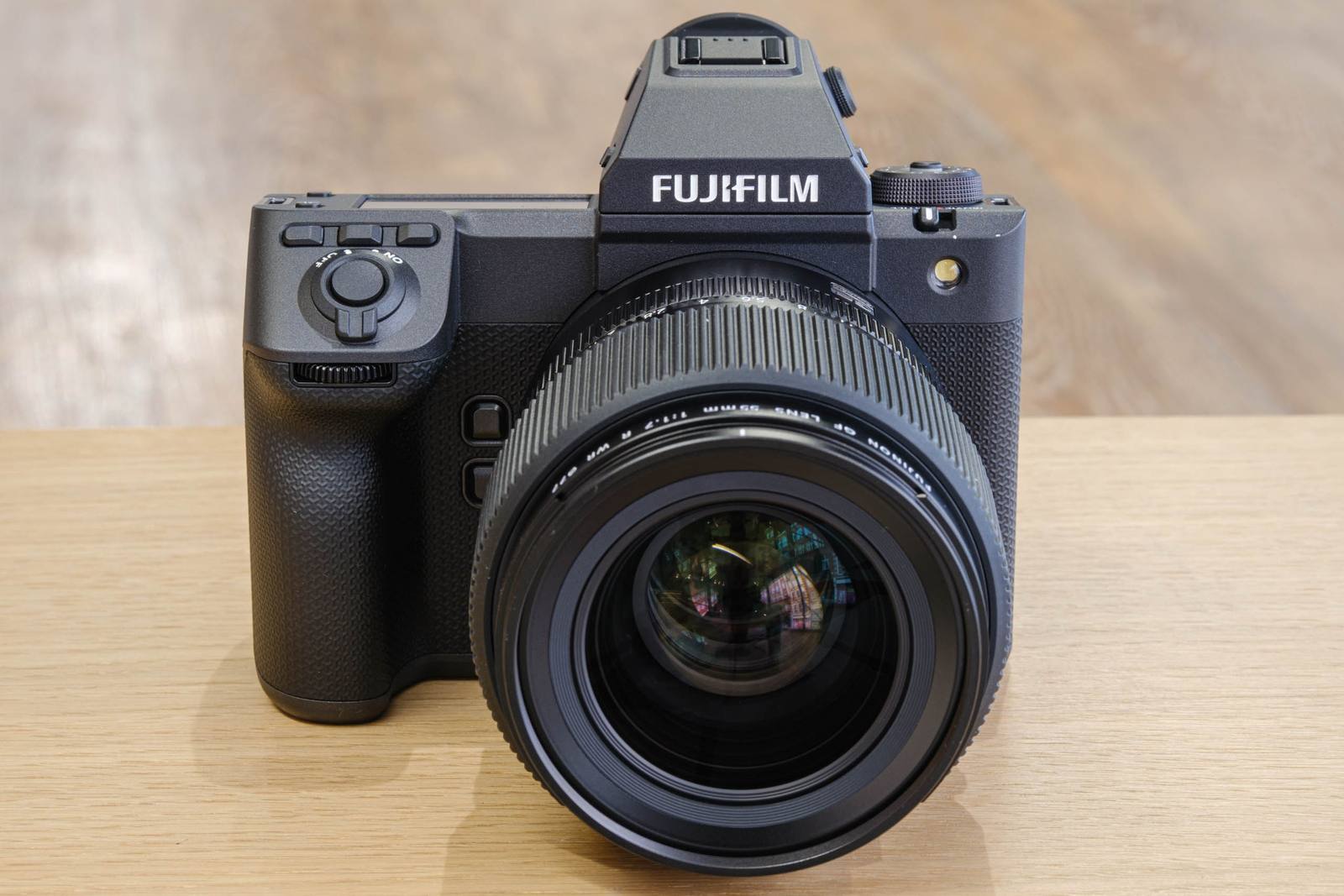
The GFX100 II, announced on 12 September 2023 at a manufacturer's suggested retail price of $7,499.95, changed the conversation from resolution to responsiveness. Its new 102-megapixel CMOS II HS sensor reads out about twice as fast as the GFX100S sensor, and paired with the X-Processor 5 it delivers continuous shooting up to 8 frames per second, subject-detection autofocus, 8-stop in-body stabilization and 8K video. For the first time, a medium-format camera could credibly keep pace with a flagship full-frame body.
Fujifilm then pushed the price of entry down again. The GFX100S II arrived in May 2024 at $4,999 with the same sensor and processor as the flagship, minus some speed and video headroom. And in March 2025, at a launch event in Prague, the company announced the GFX100RF: the first fixed-lens camera in GFX history, pairing the 102-megapixel sensor with a newly developed 35mm f/4 leaf-shutter lens (28mm full-frame equivalent), an aspect-ratio dial and a 735-gram body, the lightest in the system, at $4,899.
Why it worked
The strategy rested on a simple observation about where photographers come from. A Fujifilm manager stated publicly that 70 percent of GFX users arrived from full frame, and the system was designed to make that migration painless: familiar dials, film simulations, and handling closer to an X-T series body than to a traditional medium-format brick. The GF lens line grew alongside the bodies, including fast glass like the GF 55mm f/1.7 R WR announced with the GFX100 II at $2,299.
The competitive picture is now genuinely interesting. Hasselblad's X2D II 100C, at $7,400, offers a more purely photographic, video-free take on the same sensor size, while high-resolution full-frame bodies undercut both on price. Fujifilm's answer is that sensor area remains the one advantage that cannot be computed away, and nine years of GFX development suggest a growing number of photographers agree.
Spotted an error? We correct openly: see our corrections policy.