feature
ARRI Puts LogC3 in a Phone
The HONOR Magic9 Pro Max carries native ARRI LogC3, the ARRI Look Library and the company's logo on the device itself: the 109-year-old cine house's boldest move yet into content creation.
ARRI / HONOR
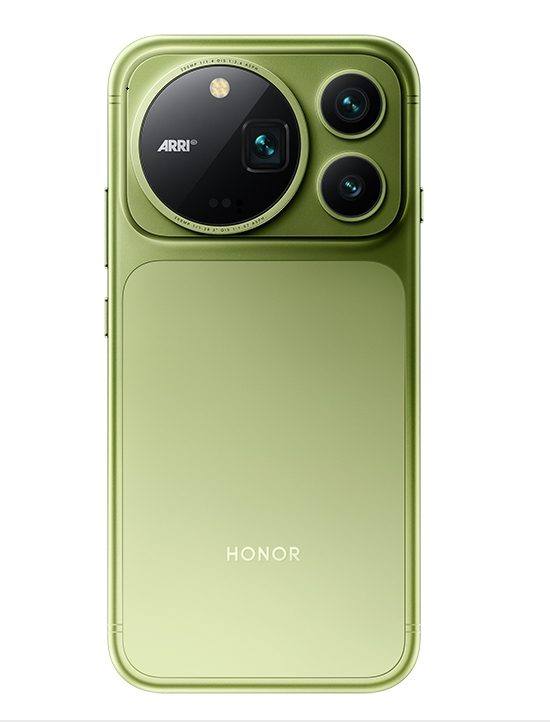
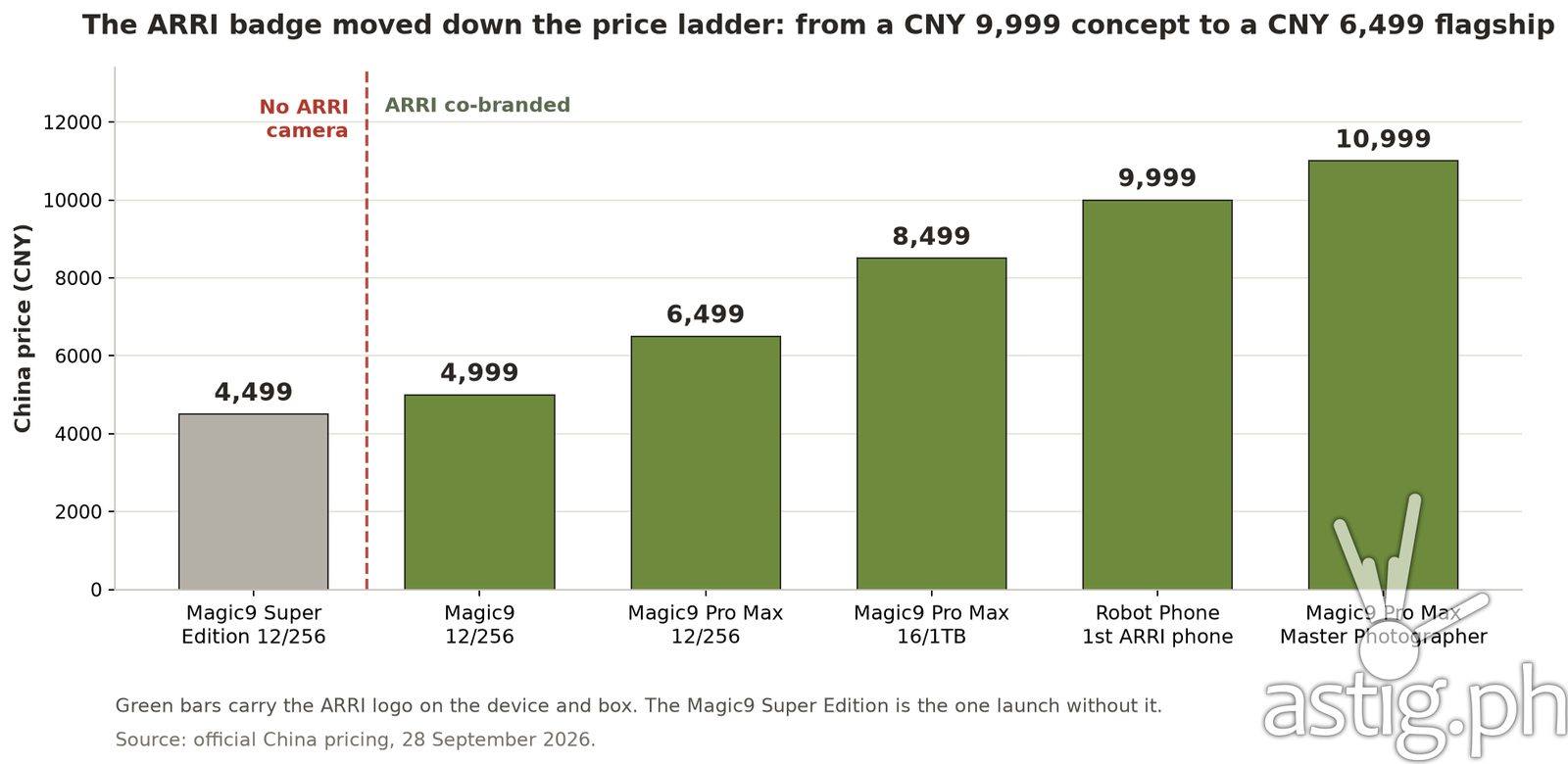
On September 28, a joint press release from Munich did something that has not happened in 109 years: it put the ARRI name on a smartphone. The HONOR Magic9 Pro Max, unveiled in Beijing the same day, integrates what the German company carefully calls selected elements of ARRI Image Science, and it carries the ARRI logo on the device and its packaging. The Robot Phone of August introduced the partnership; the Magic9 Pro Max is the first device to carry the ARRI logo on the product and its packaging, at CNY 6,499 against the Robot Phone's CNY 9,999.
The wording matters. ARRI describes the contribution as spread across capture, color management, real-time preview and finishing, and concretely it is three things. Native ARRI LogC3 recording in the ARRI Wide Gamut 3 color space, a flat log curve that preserves highlight, shadow and color information for grading later. ARRI Looks, for previewing a finished look at the moment of capture, with 14 presets on the device and a library of 87 available. And the ARRI Look Library itself, new on this phone: the Robot Phone had Looks, while the Magic9 Pro Max gets the full ALEXA-side library.
ARRI / HONOR
One technical detail separates this from a logo-swap exercise. The phone records LogC3, not LogC4. LogC3 is the curve from the ALEXA Mini, AMIRA and Mini LF era, the most widely supported ARRI encoding in existence, with free conversion LUTs and native handling in every major editing and grading application. The ALEXA 35 moved to LogC4 under REVEAL Color Science to carry the dynamic range of its ALEV 4 sensor. A 1/1.28-inch phone sensor does not need that headroom, so LogC3 is the correct engineering decision rather than a compromise. There is precedent for the licensing too: Panasonic charged for LogC3 firmware on the LUMIX GH6 in 2024. ARRI knows exactly what its color science is worth.
The hardware behind the badge
The camera system is genuinely unusual. Most 200-megapixel flagships put the big sensor on the main camera and accept whatever the telephoto happens to be; HONOR put a 200MP sensor behind the periscope too. The main camera pairs a 1/1.28-inch 200MP sensor with an f/1.57 lens and gimbal-level stabilization, while the 85mm-equivalent periscope telephoto carries a 1/1.4-inch 200MP sensor at f/2.6. A 50MP ultra-wide and a 55MP front camera round out the set. Processing runs on HONOR's own 6nm Imaging Chip H1, rated at 18.8 TOPS per watt, and the company claims an 8dB signal-to-noise improvement and up to 14 stops of cinematic dynamic range. Those are manufacturer figures, and they are exactly the kind of numbers that need real footage to test.
Video is where the ARRI work concentrates. ARRI CINEMA MODE pulls resolution, frame rate, shutter, ISO, white balance, focus, aspect ratio and audio into a single manual-style interface, recording up to 4K at 60 frames per second in 10-bit LogC3, with APV 10-bit 4:2:2 recording. Frame rates reach 4K at 120 and 1080p at 240. Even the physical design carries the reference: the camera module reinterprets the three-lens turret of ARRI's 1937 ARRIFLEX cameras as an asymmetrical 1+2 arrangement, and ARRI produced a dedicated version of its logo optimized for miniaturized reproduction next to the lenses.
ASTIG
The zoom story
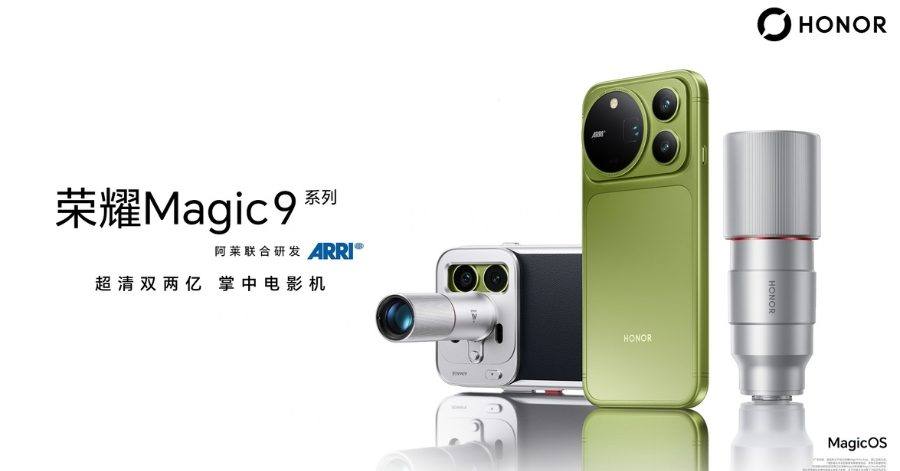
The part that could genuinely change how people shoot is sold separately. HONOR offers two clip-on teleconverters for the 85mm telephoto: the G200 extends it to a 200mm equivalent at 88 grams, and the G500 reaches a 500mm equivalent with a 5.88x optical extension. A SmallRig video rig adds mounting points for conventional setups. HONOR's own pre-launch samples included shots at 85mm, 500mm and 1000mm, and a 1000mm handheld phone shot is a genuinely difficult thing to stabilize, which is why the stabilization systems matter as much as the focal length.
Why ARRI is doing this
David Bermbach, ARRI's chief product officer, frames the partnership as recruitment: the phone gives ARRI an opportunity to introduce up-and-coming cinematographers to the brand early in their creative journey. The Munich company, founded in 1917 and holder of twenty Scientific and Technical Awards from the Academy plus six Engineering Emmys, is explicitly pushing into what it calls Content Creation alongside its motion picture and live entertainment businesses. As mobile devices become central to branded communication, social content and documentary work, ARRI is bringing professional imaging principles to a field where speed, accessibility and cinematic quality increasingly have to work together.
The deliberate contrast is with how the other camera brands do phones. Leica, Hasselblad and ZEISS have all licensed their names to phone makers, but those partnerships were framed around stills photography. ARRI's angle is the moving image, and the difference is visible in the mode names and in the pipeline: this is not a filter partnership, it is a color pipeline and a workflow, from LogC3 capture through the Look Library to professional post.
The phone launches first in China, with more markets to follow, in Moss Green, Glacier Silver and Shadow Black. Full pricing runs from CNY 6,499 for 12GB with 256GB to CNY 8,499 for 16GB with 1TB, with a Master Photographer Package at CNY 10,999. It is not sold in the United States, where HONOR does not currently operate. For everyone else, the question is whether ARRI's color science in a pocketable device is worth the premium over the badge-less competition. The company that defined what cinema looks like for a century is betting that the next generation of cinematographers will learn its look on a phone. It is not an obviously wrong bet.
Spotted an error? We correct openly: see our corrections policy.