news
Fujifilm Brings the Square Back, With a Filter Chosen Before the Shutter
The instax SQUARE 2 succeeds the 2020 SQ1 with a physical Mood Filter Switch, a new Landscape mode and a softer new film, SQUARE SOFT HAZE. The camera is priced at $119.95 in the United States.
Fujifilm
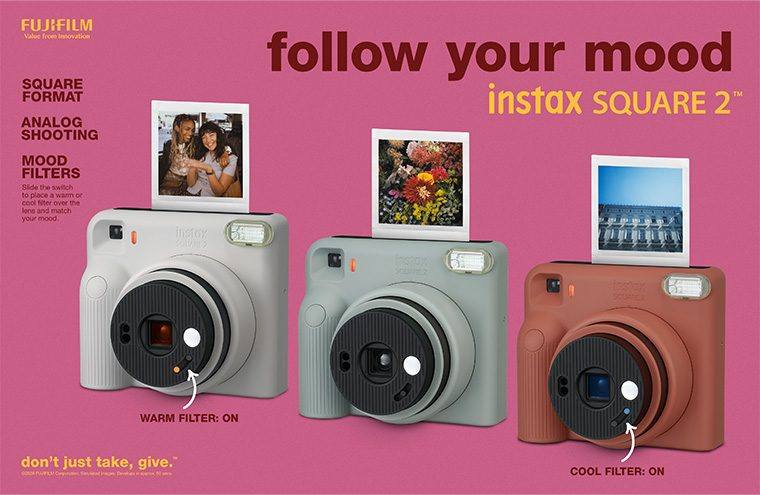
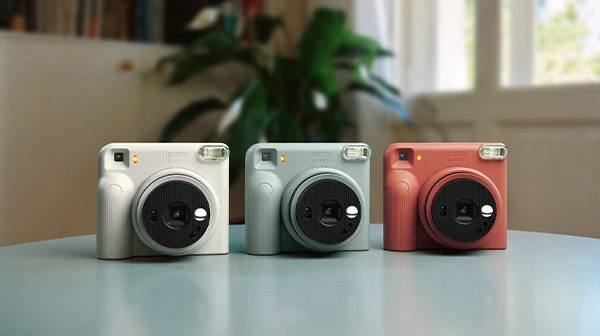
Fujifilm has returned to the square. On October 14 the company announced the instax SQUARE 2, a fully analogue instant camera that succeeds the instax SQUARE SQ1 of 2020 and restarts a part of the instax range that had been left quiet for six years. The headline change is not digital. A small switch beside the lens, which Fujifilm calls the Mood Filter Switch, slides a physical filter in front of the lens before the shutter fires. Alongside the camera comes a new film, instax SQUARE SOFT HAZE, built on a newly developed emulsion and tuned for a softer and warmer result than standard instax stock.
The positioning is deliberately simple. The SQUARE 2 is an entry level camera in a range that now spans three print formats: the card sized mini, the square, and the larger WIDE. It keeps the operating idea that defined the SQ1. Twist the lens to switch the camera on, frame the subject, press the shutter, and the print develops. What has changed is how much the photographer is asked to decide before that press, and that is where the interest in this modest camera lies.
A decision made in glass
Most colour decisions in modern photography happen after exposure, on a screen, and they can be revised without cost. The Mood Filter Switch reverses that order. In its Warm position the filter gives the print a subtle golden cast. In Cool it pushes the image toward a crisper and bluer rendering. In Off the camera records the scene as standard instax film sees it. Because the filter sits in the light path, the choice becomes part of the negative itself. There is no unfiltered version waiting in a memory card, and no later edit that restores what the filter removed.
That irreversibility is the point of an instant system, and Fujifilm is leaning into it rather than apologising for it. A physical filter also behaves differently from a digital profile. It works on the actual light of the scene, so its effect shifts with the weather, the hour and the subject in front of the lens. Two frames taken minutes apart can carry the same setting and still look distinct. For a product aimed at everyday moments rather than technical control, that variability is a feature: the camera offers one clear creative lever, placed where the hand already is, and leaves the rest alone.
Fujifilm
Three modes on a twisting lens
The lens barrel does double duty. Rotating it powers the camera and selects between three shooting modes matched to subject distance. Close-up Mode covers nearby subjects and self portraits. Standard Mode handles everyday photography. Landscape Mode is new to the square line and is intended for distant subjects, landscapes and group photographs, where the earlier camera offered no dedicated setting. The addition is small and telling: it acknowledges that a 1:1 frame is often chosen precisely for scenes with depth, not only for faces at arm's length.
The supporting systems stay automatic. Automatic Exposure adjusts shutter speed and flash output to the scene, and Automatic Flash is retained from the SQ1. A selfie mirror is built in beside the lens for checking composition. Power comes from four AA batteries, which the camera ships with, alongside a hand strap and a quick start guide. The body pairs straight lines with large curved surfaces and striped detailing on the grip and lens, and it arrives in three colours: Slate Blue, Misty White and Brick Red.
A film that softens on purpose
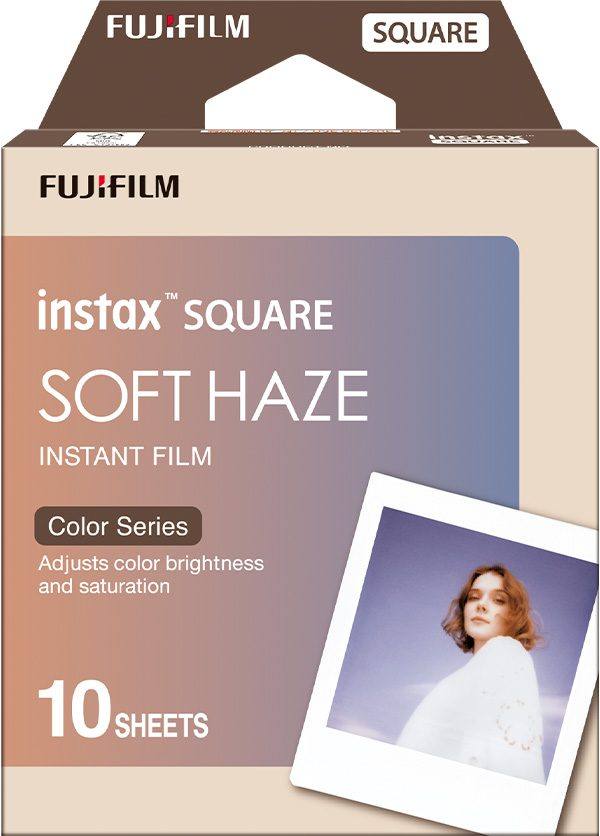
SOFT HAZE deserves attention in its own right, because new instant emulsions are rare. Fujifilm describes a newly developed emulsion that lowers saturation and contrast, producing glowing highlights and warm, diffused shadows. The company positions it for portraits, skin tones, sunlit interiors and travel landscapes, the subjects where standard instax rendering can feel brisk and literal. Each pack holds 10 exposures, as instax packs do, and the film works in the SQUARE format, so existing square camera owners are part of its market from the first day.
Fujifilm
Pricing keeps the camera in impulse territory. In the United States the SQUARE 2 carries a suggested price of $119.95, or $139.99 in Canada, with availability expected in late October 2026. In Japan the launch begins on October 28, 2026. SOFT HAZE is priced at $18.99 per pack in the United States, also expected in late October. A matching camera case and an acrylic frame for square prints complete the launch range.
What the square return signals
Read as strategy, the launch says Fujifilm still believes the square format needs a current, inexpensive camera rather than a legacy one. The mini format dominates instax sales and the WIDE format owns the large print niche, but the 1:1 frame remains the most compositionally distinctive of the three, equally at home with a portrait and the space around it. Giving that format a fresh body, a new film and a single well judged creative control is a measured investment, not a nostalgic gesture. The SQUARE 2 does not try to be a serious camera. It tries to make the decision before the shutter feel like the photograph, and on that narrow and honest brief, it is well aimed.
Spotted an error? We correct openly: see our corrections policy.